

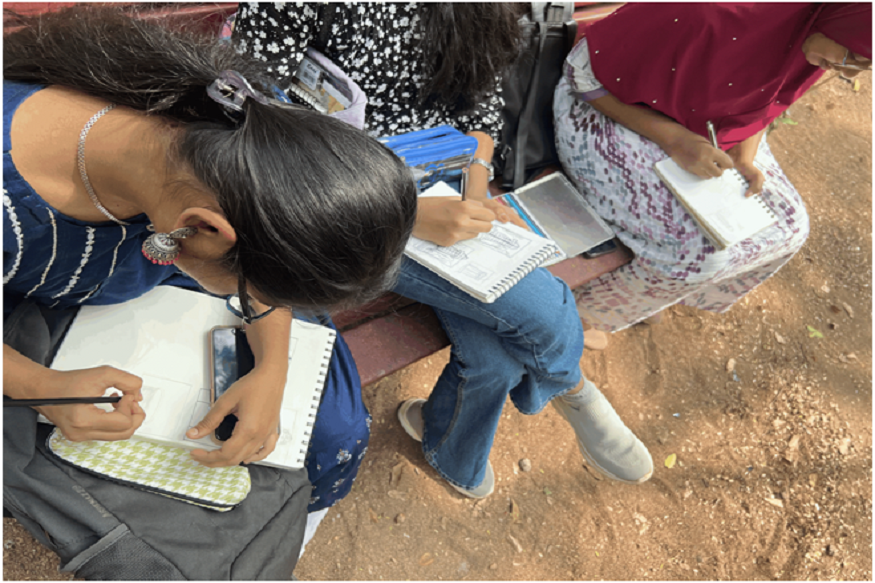
When students first hear about the UCEED (Undergraduate Common Entrance Examination for Design), many assume it is similar to other design entrance exams—heavily dependent on drawing skills and artistic ability. This assumption often leads students to focus disproportionately on sketching while overlooking the most critical component of the exam: logical and analytical thinking.
UCEED is conducted by IIT Bombay, and its structure reflects the academic and problem-solving mindset associated with technical institutions. While sketching does play a role, UCEED is fundamentally a test of how well a student can observe, analyse, reason, and make decisions under time pressure.
Understanding this distinction early can dramatically change how students prepare—and how successful they ultimately are.
Understanding the Purpose of the UCEED Exam
UCEED was introduced to identify students who are suited for design education within a technical and analytical environment. Unlike exams that focus on expressive creativity, UCEED aims to assess whether a student can combine creativity with logic.
The exam is designed to answer questions such as:
- Can the student analyse unfamiliar problems?
- Can they identify patterns and relationships?
- Can they visualise objects and spaces logically?
- Can they make quick, reasoned decisions?
Sketching is used only where it supports these skills—not as an end in itself.
Breaking Down the Structure of UCEED
To understand why logical thinking is so important, it helps to look at how UCEED is structured.
Part A: Objective and Logic-Driven
Part A carries the majority of the weightage and consists of objective-type questions. These questions test:
- Visual and spatial reasoning
- Observation and attention to detail
- Logical deduction
- Pattern recognition
- Analytical thinking
Many of these questions do not require drawing at all. Instead, they demand quick interpretation and elimination of incorrect options.
Part B: Limited but Purposeful Sketching
Part B usually includes a drawing or design-based question. However, even here, sketching is evaluated based on:
- Idea clarity
- Relevance to the problem
- Logical explanation
Highly detailed drawings without strong reasoning rarely score well.
Why Strong Sketchers Often Struggle in UCEED
One of the most surprising trends in UCEED results is that students who are confident sketchers do not always perform well. This is not because sketching is unimportant, but because UCEED rewards thinking before execution.
Common reasons sketch-oriented students struggle include:
- Spending too much time on Part B
- Ignoring the logic-heavy nature of Part A
- Overthinking visual questions instead of applying reasoning
- Panicking when questions feel unfamiliar
UCEED is designed to challenge assumptions and test adaptability—not rehearsed skills.
What Logical Thinking Means in the Context of UCEED
Logical thinking in UCEED is not limited to mathematics or formulas. It includes a broad range of cognitive skills.
1. Observation and Attention to Detail
Questions often include visual information where small details matter. Missing one element can change the entire answer.
2. Pattern Recognition
Students are asked to identify relationships, sequences, or visual patterns. This requires structured thinking rather than intuition alone.
3. Spatial Visualisation
Many questions test the ability to imagine objects in different orientations or understand how shapes relate in space.
4. Cause-and-Effect Reasoning
Some problems assess whether a student can predict outcomes based on changes in a system or condition.
All of these skills rely on logic first, sketching second.
| NIFT Coaching Classes in Hyderabad | NID Coaching centres in Kerala |
| UCEED Coaching centre in Kochi | CEED Coaching classes in Cochin |
How Logical Thinking Is Different From School Learning
In school, students are often rewarded for:
- Memorising formulas
- Following fixed procedures
- Reaching one correct answer
UCEED breaks away from this model. It presents unfamiliar problems and evaluates how students approach them.
There may not be an immediately obvious answer. Students must:
- Analyse information quickly
- Eliminate incorrect choices logically
- Trust their reasoning
This is why students who rely solely on practice papers without understanding concepts often feel overwhelmed.
How Class 11 and 12 Students Should Prepare Differently
Effective UCEED preparation begins with changing the approach—not increasing practice hours.
Focus on Thinking Exercises
Instead of repetitive sketching, students should practise:
- Visual puzzles
- Logical reasoning problems
- Observation-based questions
Balance Speed and Accuracy
Part A is time-sensitive. Students must learn to:
- Move on from difficult questions
- Avoid spending too long on one problem
- Make educated decisions
Practise Under Exam Conditions
Mock tests help students understand pressure and pacing, which are critical for UCEED success.
How UCEED Differs From Other Design Exams
UCEED is often compared to exams like NID or NIFT, but the evaluation philosophy is different.
- UCEED emphasises objective reasoning more strongly
- Questions are less subjective
- There is a greater focus on elimination and accuracy
This does not make UCEED easier or harder—it makes it different.
Students who understand this distinction prepare more effectively.
Common Preparation Mistakes to Avoid In UCEED Exam
- Treating UCEED like a drawing exam
- Ignoring logical reasoning practice
- Focusing only on previous-year questions without analysis
- Underestimating the importance of speed
These mistakes often stem from misunderstanding what the exam is designed to test.
Why Structured Preparation Helps for UCEED
Because UCEED is logic-driven, many students struggle to assess their own progress. They may practise extensively but fail to improve scores.
Structured guidance helps students:
- Understand question types
- Learn elimination strategies
- Improve time management
- Identify personal weak areas
This is why students preparing seriously for UCEED often seek UCEED coaching for preparation—not to memorise answers, but to develop the reasoning approach required by the exam.
The right guidance helps students align their preparation with how IITs actually evaluate aptitude.
What Parents Should Understand About UCEED
For parents, it’s important to know that UCEED is not testing “talent” in the traditional sense. It is testing thinking ability and adaptability.
Students who perform well are often those who:
- Stay calm under pressure
- Trust their reasoning
- Learn from mistakes
These are long-term skills with value beyond the exam.
Final Perspective
UCEED is not a sketching competition. It is a test of how a student thinks when faced with unfamiliar problems.
Students who recognise this early shift their focus from perfect drawings to strong reasoning—and that shift often makes all the difference.
Logical thinking is not separate from creativity in UCEED; it is the foundation that supports it.
For students who prepare with clarity rather than assumptions, UCEED becomes not just manageable, but meaningful.